Every year, on 1 November, the cemeteries of Guadeloupe light up. As night falls, thousands of candles turn the alleyways into rivers of light, families gather around the graves, and the atmosphere is nothing like the silent contemplation of All Saints’ Day in mainland Europe.
If you are staying in Bouillante in early November, you will be a few minutes away from one of the island’s most beautiful traditions. Here is what to know about it, and how to attend respectfully.
All Saints’ Day, a festival of light
In Guadeloupe, All Saints’ Day is not a day of sadness: it is a family reunion. The dead are honoured together, often across several generations, and there is as much talk of the living as of those who have gone.
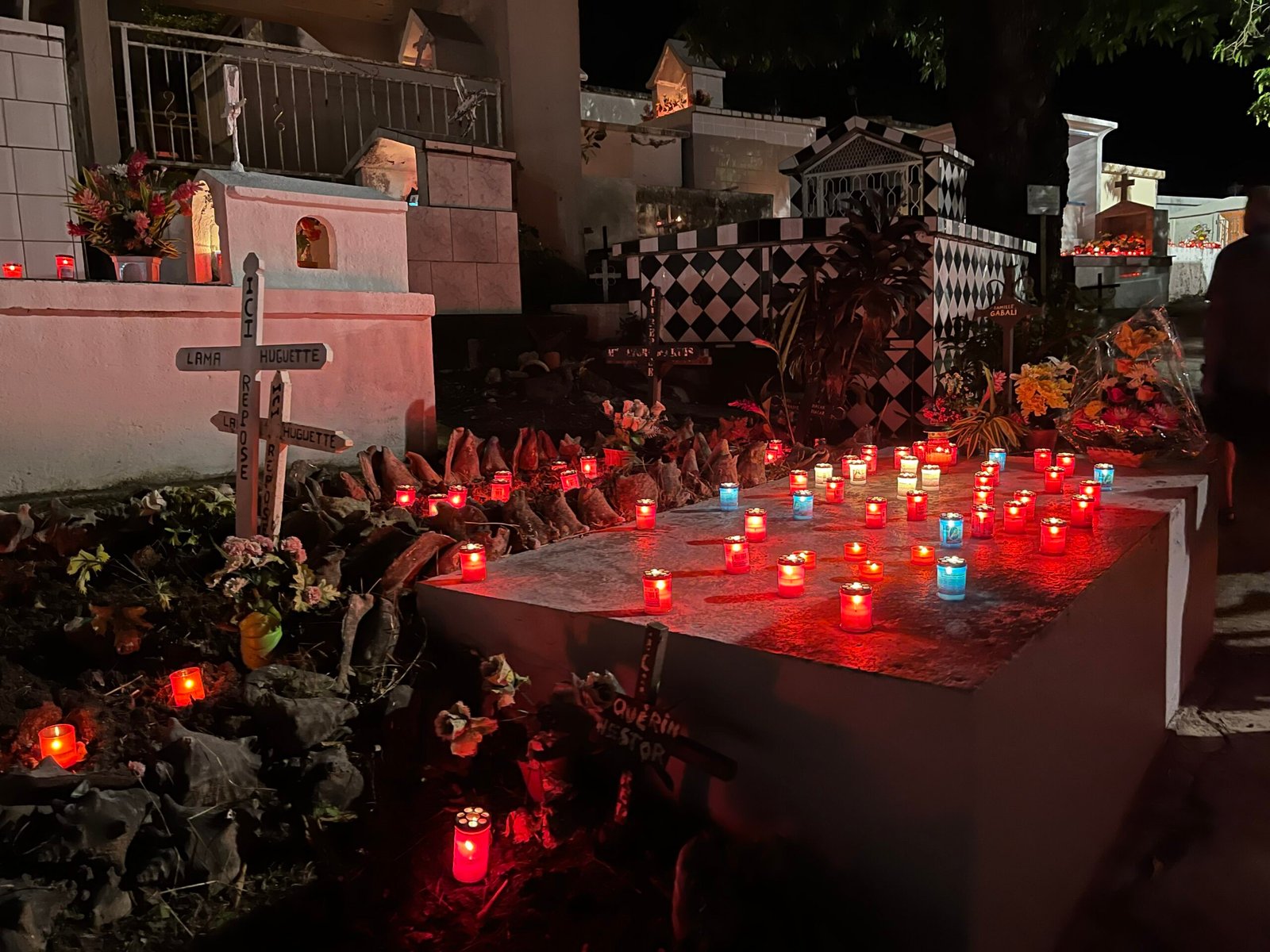
The most visible difference with mainland France is the flowers: here it is not chrysanthemums that dominate, but candles. They are lit by the hundred on every grave, and it is this illumination that makes the night of 1 November unique. Guadeloupeans call it the night of the clindindins, after the Creole word for fireflies.
The days before: cleaning the graves
The celebration begins well before 1 November. In the preceding week, families go to the cemetery to clean and repaint the graves: weeds are pulled up, the white paint is freshened, and the black-and-white tiles typical of Caribbean tombs are washed.
The local councils take part in the effort, and collective clean-ups are organised across the island. If you drive past a cemetery in late October, you will see this ballet of ladders, buckets and paintbrushes: it is already part of the celebration.
The night of 1 November
Everything happens at dusk. Families arrive with boxes of candles, sometimes lanterns, and cover the graves in flame. Within an hour, the cemetery is transformed.
A vigil, not a silent tribute
People settle in, share a meal, drink a punch, tell stories. Neighbouring families greet each other, children run along the paths, songs and prayers rise here and there. The mood is warm and sociable, without any loss of respect for the dead.
The Semblani
At the same time of year, Guadeloupean families of Indian descent celebrate the Semblani, a ceremony inherited from South India: the home is decorated with candles and ritual meals are prepared in memory of those who have died. Two different traditions, the same attention to light and sharing.
The cemetery of Bouillante, minutes from the property
You do not need to cross the island to see this. The cemetery of Bouillante is one of the most endearing on the Côte-sous-le-Vent: a village cemetery on a human scale, with its tiled tombs, white crosses and old graves.
On the evening of 1 November it lights up like every cemetery on the island, but in a more intimate setting than the well-known sites: here it is the families of the town who gather, among themselves, as they have done for generations.
It lies just outside the village centre, and access is easy: you can park without trouble at the municipal stadium car park, a few minutes away on foot. That is the safest option on the evening of 1 November, when the streets around the cemetery are crowded.
What strikes visitors most is the welcome. The families of Bouillante are remarkably warm and conversation comes easily: they will gladly tell you their family history, show you where their relatives are buried, and it is not unusual to be invited to come closer and pay your respects. Simply accept, without a camera in your hand: that is the whole spirit of the evening.
The great cemetery of Morne-à-l’Eau, famous for its black-and-white chequerboard tombs rising in tiers up the hillside, is the other spectacle of that night. It is in Grande-Terre, about 1 hour 15 minutes’ drive from Bouillante: a possible outing, but one that means leaving early and accepting the crowds.
Attending as a visitor: our advice
A cemetery is not a tourist attraction: it is a place of remembrance where families gather around their dead. You are welcome to attend as a visitor, provided you show some consideration.
- Arrive at nightfall, around 6 pm, when the candles have just been lit.
- Dress appropriately: no swimwear or beach clothes.
- Ask before photographing a grave or a family, and avoid the flash.
- Keep your voice down and let people pass: the paths are narrow and busy.
- Park at a distance: parking is saturated around cemeteries that evening.
- A word is enough: a “bonsoir” or a “bon kouraj” is always well received.
November in Bouillante
1 November 2026 falls on a Sunday. It is also the start of the Route du Rhum from Saint-Malo: the first boats are expected off the Côte-sous-le-Vent a week later. November is therefore a lively month, when the town lives to the rhythm of both tradition and the race.
As for the weather, the rainy season is ending: showers become rarer, the sea stays warm and the island is still reasonably quiet before the high season begins in December.
Between outings, you will find the water activities at Malendure and, to choose where to put down your bags, our guide to where to stay in Bouillante.
Frequently asked questions
When do the cemeteries light up in Guadeloupe?
On the evening of 1 November, from nightfall. Families often stay late into the night.
Can a tourist visit a cemetery that evening?
Yes, as long as you stay discreet: appropriate dress, a low voice, and no photographs of families without their permission.
Which cemetery can I see from Bouillante?
The one in the village of Bouillante, close by and more intimate. For the most spectacular, allow about 1 hour 15 minutes’ drive to Morne-à-l’Eau, in Grande-Terre.
What is the night of the clindindins?
It is the name given to the night of 1 November, after the Creole word for fireflies: the thousands of candles lit on the graves recall their light.
Stay in Bouillante
Studio Marlin and the Kaz’Basse and Foufou bungalows are in Bouillante, on the Côte-sous-le-Vent, 3 km from Malendure beach and the Cousteau Reserve. Book direct with the owners: a pool, and €60 to €100 per night.
Discover our rentalsRequest a quote