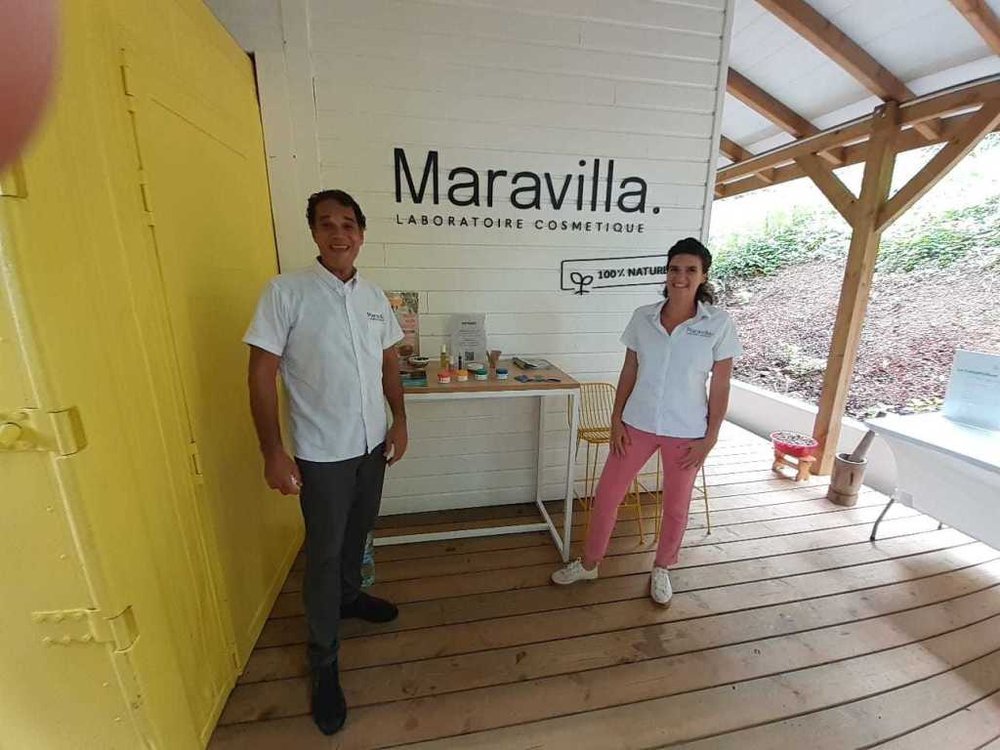
At Petit-Bourg, less than an hour’s drive from Bouillante, a Guadeloupean cosmetics brand makes its balms in the middle of its own forest. And it opens its doors: on Saturday mornings, Aude and Jean-Paul Daanen welcome visitors to the Maravilla laboratory to explain how a seed picked up off the forest floor becomes an oil, and then a balm.
The visit lasts two hours, part of it in the forest, and must be booked in advance. Here is what you see, what it costs, and how to fit it into a stay on the Côte-sous-le-Vent.
A guided visit, on Saturday morning
Visits run on Saturdays, from 9.30am to 11.30am. Two hours, then, and nothing like a factory tour seen through glass: you walk, you listen, and you get your hands into the raw material. The morning comes in three parts.
- a walk through the medicinal garden and the forest around the laboratory, along with the story of the brand;
- an explanation of how the seed is transformed, from collection to drying and then oil extraction;
- a tour of the laboratory itself and the techniques used, hands included: visitors take part in processing the calophyllum seeds themselves.
That last part is what makes the difference. You understand fairly quickly why a small bottle of galba oil costs what it costs once you have seen for yourself how many seeds go into it, and how long they need to dry.
The visit ends with the products, which you can buy on site: balms, scrubs, soaps and oils. For a present to take home, it beats the airport shops by a wide margin.
Galba, the green gold of the Caribbean
It all starts with a tree you see all along Caribbean shorelines, with a gnarled trunk and thick glossy leaves: the galba, known to botanists as Calophyllum inophyllum and also called calophyllum. Its fruit falls to the ground by the thousand, and for a long time nobody did anything with it.
Each fruit holds a kernel that yields a thick oil, dark green and unmistakable, with a strong scent. In Guadeloupe as elsewhere in the Caribbean, family remedies have used it for generations on skin, scars and aching joints; it is sometimes called the green gold of the Caribbean. In Polynesia, the same seed gives the better-known tamanu oil.
Between the seed on the ground and the finished oil there is mostly patience: the kernels have to dry for several weeks before they will give up their oil in the press. The visit follows that whole chain, from the forest floor to the bottle.
A laboratory in the middle of the family forest
Maravilla was founded in 2022, on land the Daanen family bought at Petit-Bourg back in the 1960s. Aude and Jean-Paul Daanen trained in oil extraction in French Polynesia, where calophyllum has been worked for far longer, before setting up their own workshop.
The laboratory stands in the middle of their forest, a few metres from the trees that supply the raw material, and it is self-sufficient in water and electricity. The formulas use no synthetic preservatives, and production waste is composted on site. None of that is a brochure claim: it is precisely what the visit lets you check with your own eyes.
The couple also turned their garden into a medicinal garden, planted with useful species from the Creole pharmacopoeia — and that is where the walk begins.
Balms that made it to the Élysée Palace
The ranges have short, telling names: CICAT, RELAX, TONIK, SOLÈY, BÒM. The Cicat balm was chosen among the 122 products shown at the Grande Exposition du Fabriqué en France, at the Élysée Palace, in October 2024: one product per French department, and this was the one representing Guadeloupe.
The brand is now sold in around sixty retail outlets, in Guadeloupe, Martinique, Haiti and mainland France. The start was anything but smooth: after being turned down by the banks, it was a €20,000 honour loan from Initiative Guadeloupe in 2023 that got the project moving — “decisive for our project”, as the founders put it. In September 2026, Maravilla received the Impact+ prize from the Initiative network, awarded at the Banque de France in Paris, as one of ten winners.
What comes next is already mapped out: EcoCert certification, then ISO 9001. In other words, the small business you visit on a Saturday morning is no amateur workshop.
Prices, dates and what to bring
The visit at a glance
- Where: at Petit-Bourg, on the laboratory’s own land. The exact address and meeting point are given when you book;
- When: Saturdays, 9.30am to 11.30am — two hours;
- Price: €13 to €16 per person, with an adult and a child rate;
- Group: minimum six people. Private bookings are possible, with the same minimum. If the minimum is not reached, the session may be postponed up to 24 hours beforehand;
- Booking: online, on the activity page of the Caraïbes Factory website, which sells the visit;
- Cancellation: not turning up, or cancelling less than 48 hours in advance, means the ticket is lost and not refunded;
- What to bring: shoes suitable for walking, and a raincoat depending on the weather;
- Accessibility: part of the experience takes place in the forest, so you need to be able to manage the walk. The visit is not accessible to visitors with reduced mobility.
Dates are released in batches, a few weeks ahead: at the time of writing, Saturday 10 October, 7 November and 5 December 2026 are open. It is worth booking as soon as your dates are set, all the more so since the six-person minimum fills the slots quickly in high season.
Getting there from Bouillante
From Bouillante, allow 45 minutes to an hour on the Route de la Traversée (the D23), the road that crosses the col des Mamelles through the heart of the Guadeloupe National Park. For a 9.30am start, leaving around 8.15am gives you room: the road winds, and it is often wet in the morning.
The drive is one of the finest on the island, and it would be a shame to do it twice without stopping. On the way back, the Cascade aux Écrevisses waterfall and the Maison de la Forêt are both on the D23, minutes from the laboratory — an easy way to stretch out the morning without a detour.
With the visit finished at 11.30am, you are back at the property for lunch, and the whole afternoon is left for Malendure beach and the water activities of the Cousteau Reserve. A well-filled Saturday morning, in short.
Frequently asked questions
Can you visit the Maravilla laboratory without booking?
No. Visits take place on Saturday mornings, by prior booking and with a minimum of six participants: simply turning up at Petit-Bourg is not possible.
How much does the visit cost?
€13 to €16 per person, with an adult and a child rate.
How long does it last?
Two hours, from 9.30am to 11.30am.
Is the visit suitable for children?
Yes — there is a child rate, and handling the seeds usually goes down very well. They do need to be able to walk in the forest, so bring closed shoes.
How far is it from Bouillante?
Between 45 minutes and an hour by road, on the Route de la Traversée (D23).
Can you buy the products on site?
Yes, at the end of the visit. They are also sold in around sixty retail outlets in Guadeloupe, Martinique, Haiti and mainland France.
Stay in Bouillante
Studio Marlin and the Kaz’Basse and Foufou bungalows are in Bouillante, on the Côte-sous-le-Vent, 3 km from Malendure beach and the Cousteau Reserve. Book direct with the owners: a pool, and €60 to €100 per night.
Discover our rentalsRequest a quote

